Fraud Knocking? Why Older Canadians Aren’t Answering the Door
New HomeEquity Bank Data Shows Prudence, Not Paranoia, Drives Doorstep Decisions
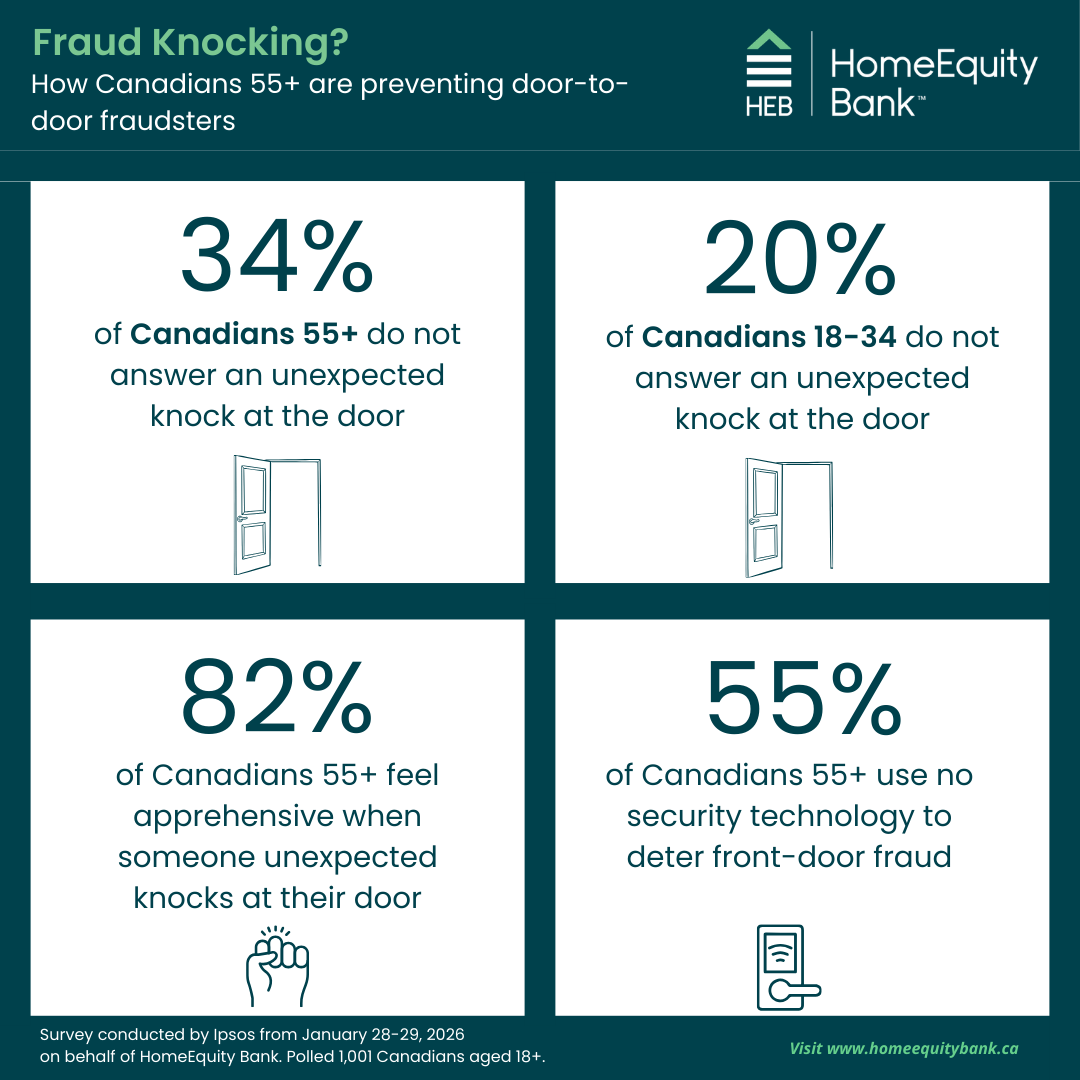
TORONTO, ON – March 2, 2026 – While popular culture claims younger generations invented ignoring a knock on the door, a new national survey reveals that older Canadians are actually far more likely to screen unknown would-be visitors. The Ipsos research, commissioned by HomeEquity Bank, found that more than one-third (34%) of Canadians aged 55+ will not answer their door to an unexpected caller, a rate 70 per cent higher than among younger adults aged 18-34 (20%).
This behaviour is not just a social quirk; it’s a savvy defence mechanism. With the Canadian Anti-Fraud Centre (CAFC) identifying service-related scams as one of the top three most reported types of fraud in the country targeting older Canadians, this caution is a direct response to a real threat at their front door.
“This new research reveals that older Canadians are among the savviest and most vigilant group when it comes to unexpected knocks at the door. They approach these situations with a healthy sense of caution, screening visitors more than any other demographic,” said Yvonne Ziomecki-Fisher, Chief Customer, Brand and Advice Officer at HomeEquity Bank. “They are prudent, not paranoid. Our goal is to validate their concern and introduce them to some of the technology available that enhances their control and turns apprehension into action.”
The survey found that an overwhelming 82 per cent of Canadians 55+ feel at least somewhat apprehensive when someone unexpected is at their door. Yet, despite their well-founded caution, the research also uncovered a critical opportunity: 55 per cent of this demographic use no security technology to help deter front-door fraudsters.
“Aging Canadians have shown they are savvy and comfortable online; now it’s about upgrading their toolkit,” says technology expert Marc Saltzman. “The latest technology allows them to safely press ‘pause’ on a high-pressure sales pitch at the door and verify a company’s claims or even get a virtual second opinion. It’s about equipping them with the knowledge to confidently shape their living space, so they can continue to age in the home they love.”
Saltzman recommends investigating the following technologies to help deter doorstep fraudsters:
- Video Doorbells – Give homeowners complete control to neutralize high-pressure sales tactics by allowing them to safely see, hear and speak to visitors from anywhere without ever opening the door.
- Outdoor Cameras with lights or sensors – Automatically turn on when someone pulls into their driveway or walks up to their door. This not only alerts visitors to a security measure in place but also lets the homeowner know that someone is coming to the door they might not be expecting.
- Smart locks – Allow homeowners to control access remotely and even at specific dates/times to only allow access to their home when it works for them. This can be especially helpful for aging in place individuals who have multiple home care providers visiting their home.
Other key findings from the survey:
- Trust, but Verify: Close to three in five aging Canadians (58%) use verification strategies for unexpected visitors. This number rises to 69 per cent among Canadians aged 18–34-year-olds, and 63 per cent for 35–54-year-olds. Verification strategies include the following: asking to see official identification, confirming the stated reason for the visit, looking for an official company vehicle outside, calling the company using the number on their bill or website—rather than the number provided by the visitor—or checking the company’s website or searching online.
- Suspicious Lot: What is considered a suspicious interaction varies significantly by age. A majority of Canadians aged 55 and over (55%) report not being aware of any suspicious activity at their front door. In contrast, those aged 35-54 are most likely to report unsolicited sales offers (42%), while younger Canadians (18-34) are the most likely to report being approached by strangers asking for personal information or help.
“Over 9 in 10 Canadians wants to age with dignity and freedom in the home and community they love. At HomeEquity Bank, our purpose is to help them achieve that,” said Ziomecki-Fisher. “Feeling secure is fundamental. This Fraud Prevention Month, our ‘Fraud at Your Front Door’ campaign is about more than just security hardware; it’s about ensuring older Canadians feel empowered and in control, providing a critical support that helps them live safely and confidently in their forever home.”
Canadians can find HomeEquity Bank’s ‘Fraud at the Front Door’ resources at www.chip.ca/FraudPrevention.
About HomeEquity Bank
HomeEquity Bank is a Federally Regulated Schedule 1 Canadian Bank offering a range of reverse mortgage solutions, including the flagship CHIP Reverse Mortgage product. The company was founded in 1986 to address the financial needs of Canadians who wanted to access the equity of their top asset — their home. The Bank is committed to empowering Canadians aged 55 plus to live the retirement they deserve, in the home they love. HomeEquity Bank is a portfolio company of Ontario Teachers’ Pension Plan Board, a global investor that delivers retirement income for approximately 340,000 current and retired teachers in Ontario. For more information, visit www.chip.ca.
About the Survey
These are the findings of an Ipsos survey conducted on behalf of HomeEquity Bank that was fielded between January 28-29, 2026. A total of n=1001 Canadians aged 18+ participated in the survey, which was fielded via the Ipsos panel. Quotas and weighting were used to ensure the sample’s composition reflects that of the Canadian population according to census parameters. This survey has a credibility interval of +/- 3.8 per cent 19 times out of 20, of what the results would have been had all Canadian adults 18+ been surveyed.
Media, please contact:
Rebecca Rosenberg, HomeEquity Bank, (416) 678-3183 | rrosenberg@heb.ca
Jennifer Wasley, Weber Shandwick for HomeEquity Bank, (416) 804-3014 | jwasley@webershandwick.com